

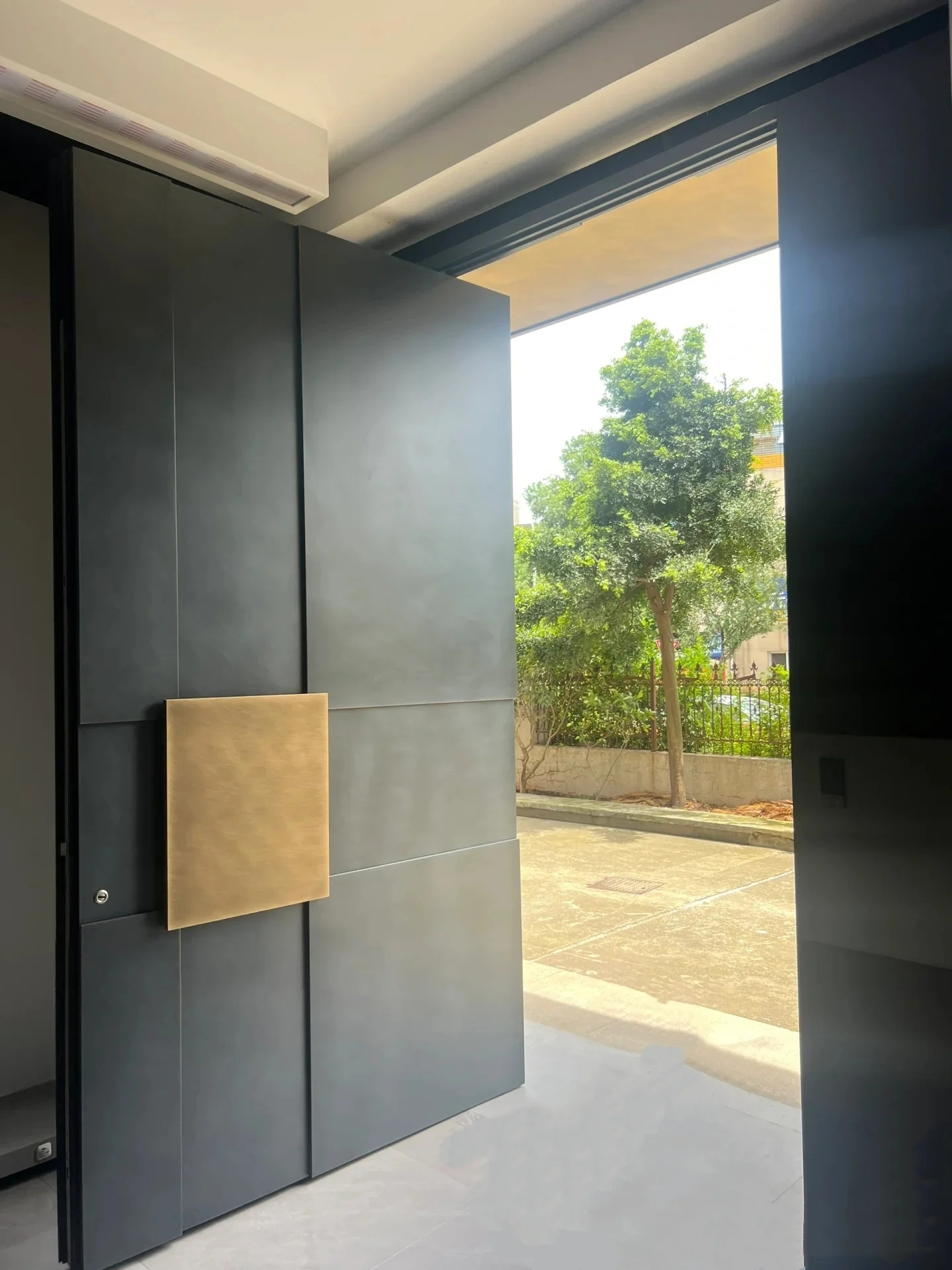
In the realm of luxury architecture, the entrance door is more than a functional barrier; it is a statement of prestige, a prelude to the design narrative within. As architects and designers push the boundaries of scale and aesthetics, oversized pivot doors have emerged as the defining feature of high-end residences, commercial landmarks, and cultural institutions. These monumental portals, often soaring up to three meters or more, command attention and create an unforgettable first impression. However, their grandeur is not merely a matter of scale; it is a triumph of engineering, requiring precision hardware capable of managing loads exceeding 500 kilograms while ensuring seamless operation and enduring durability. This article delves into the technical intricacies and design considerations of oversized pivot doors, exploring the hardware that makes them possible and the architectural impact they deliver.
## The Allure of Pivot Doors
Unlike traditional hinged doors that rotate from a side jamb, pivot doors rotate on a central vertical axis (or offset from center), allowing the door to swing both inward and outward. This unique mechanism distributes weight more evenly, enabling the use of wider and heavier door slabs without the stress concentrated on side hinges. The visual effect is striking: a massive slab of metal, wood, or glass that glides open with a smooth, almost silent motion, creating a grand, uninterrupted opening. This feature is particularly prized in luxury settings where expansive entrances are desired to blur the lines between interior and exterior spaces, or to make a bold architectural statement.
However, with great scale comes great responsibility. Oversized doors, defined here as those weighing over 500 kg or exceeding 3 meters in height, pose significant engineering challenges. Standard hinges and pivots simply cannot handle the torque and dynamic loads. This is where specialized pivot hardware steps in, offering robust solutions that ensure safety, longevity, and ease of use.
## The Heart of the Matter: Heavy-Duty Pivot Hardware
The performance of an oversized pivot door hinges (literally and metaphorically) on its hardware. For doors in the 500 kg to 1,000 kg range, and even beyond, standard commercial pivots are inadequate. Instead, engineers rely on heavy-duty pivot systems designed with forged steel or stainless steel components, precision bearings, and adjustable mechanisms. Key components include:
– **Top and Bottom Pivots**: The door is secured at the top and bottom, with the bottom pivot bearing the majority of the door’s weight. Heavy-duty bottom pivots feature large-diameter thrust bearings that can support vertical loads of up to 1,500 kg or more. These bearings are often housed in a cast iron or steel box, which is anchored to the floor and concealed beneath a flush floor plate. The top pivot guides the door and prevents lateral movement, typically incorporating a radial bearing to accommodate slight misalignments during installation.
– **Jamb and Header Mounts**: The pivot assembly is mounted to the header and threshold. In new construction, this requires precise positioning of anchor bolts, often embedded in concrete. For renovation projects, specialized mounting brackets can be used, but a structural engineer’s assessment is essential to ensure the wall and floor can support the concentrated loads.
– **Adjustability**: Even minor settling of a building can affect door alignment. Premium pivot systems feature three-dimensional adjustability—vertical, horizontal, and compression—allowing for precise tuning of the door’s alignment and seal compression. This ensures smooth operation and consistent performance over time.
– **Floor Spring Alternatives**: Some pivot doors utilize floor springs, which are heavy-duty hydraulic closers embedded in the floor. These are ideal for high-traffic commercial entrances where automatic closing is desired. For residential luxury, pivot systems with manual operation and friction hold-open features are often preferred, allowing the door to rest at any angle.
## Materials and Construction: Balancing Mass and Aesthetics
The weight of an oversized door is determined by its materials. Solid wood, steel, aluminum composite, and glass are common choices, each offering distinct aesthetic and structural characters.
– **Wood**: Solid hardwood doors, often featuring intricate veneers and joinery, can easily exceed 500 kg. However, they are susceptible to warping and require careful engineering to maintain stability. Often, a wood door is constructed with a steel or aluminum substructure to add rigidity and reduce weight, while the exterior showcases premium timber.
– **Steel**: Steel doors offer unmatched strength and can be fabricated in minimalist designs with large glazing sections. They are heavy but relatively stable. Fire-rated steel pivot doors are popular in commercial and high-end residential projects for both security and style.
– **Aluminum**: Extruded aluminum frames with infill panels such as glass, metal, or wood provide a lighter alternative, yet still large sizes can reach significant weights. Aluminum’s strength-to-weight ratio makes it a favorite for minimalist, large-format doors with slim sightlines.
– **Glass**: Full-glass pivot doors, often incorporating laminated or insulated glass, can be both stunning and heavy. A 3-meter tall, 1.5-meter wide glass door with a substantial glass thickness can easily weigh 400-600 kg. In such cases, the glass itself is often the structural element, and the pivot hardware is attached to the glass via specialized steel patch fittings or clamps.
Regardless of material, the pivot point placement is critical. Centrally pivoted doors rotate around a point located some distance from the door’s edge, typically around 250-300 mm from the door’s face and at a quarter of the door’s width. This placement reduces the required operating force and allows the door to swing only in one direction or both, depending on the design. However, the pivot point must be engineered to handle the torsional forces and ensure that the door doesn’t sag.
## Engineering for 500kg+ Load Capacity: Structural Considerations
When a door weighs over 500 kg, the forces involved are substantial. The pivot hardware alone cannot guarantee stability; the surrounding structure must be designed to transmit these forces safely to the ground. A structural engineer will consider:
– **Deflection**: The door frame and wall must have minimal deflection under load. Typically, steel reinforcement posts or headers are used to distribute the concentrated loads from the pivot mount into the building’s structural framework. In some cases, a reinforced concrete header is specified.
– **Wind Loads**: For external doors, wind loads can be enormous. A large pivot door acts as a sail, and the pivot system must resist these dynamic forces. Calculations must account for the maximum wind pressure in the region, factoring in the door’s height and width. High-quality pivot hardware is tested to withstand wind loads, and additional tie-downs or structural anchors may be necessary.
– **Seismic Considerations**: In earthquake-prone areas, the entire assembly must comply with seismic design requirements. Pivot doors should be designed to accommodate sway without binding or failing.
– **Cycle Testing**: For commercial applications, the hardware should be tested to at least 1 million cycles to ensure durability. Residential doors may require less, but quality pivots are typically graded by the number of cycles they can endure.
## Installation Precision: The Key to Longevity
A 500 kg door demands painstaking installation accuracy. The tolerance for alignment is often within 1-2 mm. Any deviation can lead to excessive wear on bearings, binding, or even structural failure over time. Therefore, the installation process involves:
– **Site Survey**: Before pouring floor or installing headers, a detailed survey ensures that the opening is perfectly plumb, square, and level. Laser levels and total stations are used.
– **Template Mounting**: The pivot hardware is often installed using jigs or templates to ensure the exact position. For floor pivots, the floor plate is bolted to a concrete substrate, and after the concrete cures, the door is hung.
– **Temporary Bracing**: During installation, doors may be temporarily braced to prevent accidental movement and to allow the alignment to be fine-tuned.
– **Final Adjustment**: After hanging, the door is adjusted in all three axes to ensure even gaps along the perimeter. Seals and weatherstripping are then set to ensure proper insulation and weather resistance.
## Aesthetic Integration: Blending Hardware with Design
Luxury architecture demands that hardware not only function flawlessly but also complement the design. Modern pivot systems offer multiple finish options—brushed stainless steel, bronze, black anodized, or even custom colors—that can be matched to the door’s frame and surrounding architecture. Concealed pivot points are often preferred for a minimalist appearance, with only a slim floor plate and header cap visible. Alternatively, for a more industrial or statement look, pivots can be exposed with decorative plates.
Additionally, door automation can be integrated for motorized operation. With weight over 500 kg, manual operation becomes impractical. Hydraulic or electromechanical openers, often driving the door via a concealed arm or from the pivot itself, allow for remote control access or automatic opening via sensors. These systems must be designed in tandem with the pivot hardware to ensure smooth, safe operation, including safety sensors to stop if an obstacle is detected.
## Case Example: A 600 kg Pivot Door in a Coastal Residence
To illustrate, consider a custom residence in Malibu, California, featuring a double-height entry with an 3.2 meters tall by 2.4 meters wide pivot door made of solid steel and glass. The total weight is 650 kg. The design team specified a heavy-duty pivot system from a leading manufacturer, with a bottom pivot rated at 1,200 kg. The floor was reinforced with steel beams beneath the pivot point, and the header was tied into the structure’s moment frame to resist wind loads from ocean breezes. Motorization was added for convenience, and the door now operates with the touch of a button, opening to reveal sweeping ocean views.
The project was delivered without compromise, demonstrating that when engineering and design coalesce, oversized pivot doors can become the centerpiece of a luxurious architectural experience.
## Conclusion
Oversized entrance pivot doors represent a pinnacle of architectural achievement, blending artistry with advanced engineering. They are not merely doors; they are dynamic sculptures that elevate the entry experience. For architects and builders undertaking such projects, understanding the hardware requirements is paramount. With heavy-duty pivot systems designed for over 500 kg loads, precision installation, and thoughtful integration of automation, these doors will provide a lifetime of smooth, impressive performance. When selecting materials, consult with a structural engineer early in the design phase to ensure that the infrastructure supports the door’s mass and wind loads. And always partner with experienced fabricators and installers who specialize in large-format doors. For those who dare to dream big, oversized pivot doors offer an unrivalled gateway to luxury.
Now, as you envision your next grand entrance, consider the engineering prowess that makes the impossible possible. The door is more than an object; it is a testament to human ingenuity, a promise of what awaits beyond. In the world of luxury architecture, pivoting to the larger scale is a decision that never goes unnoticed.