

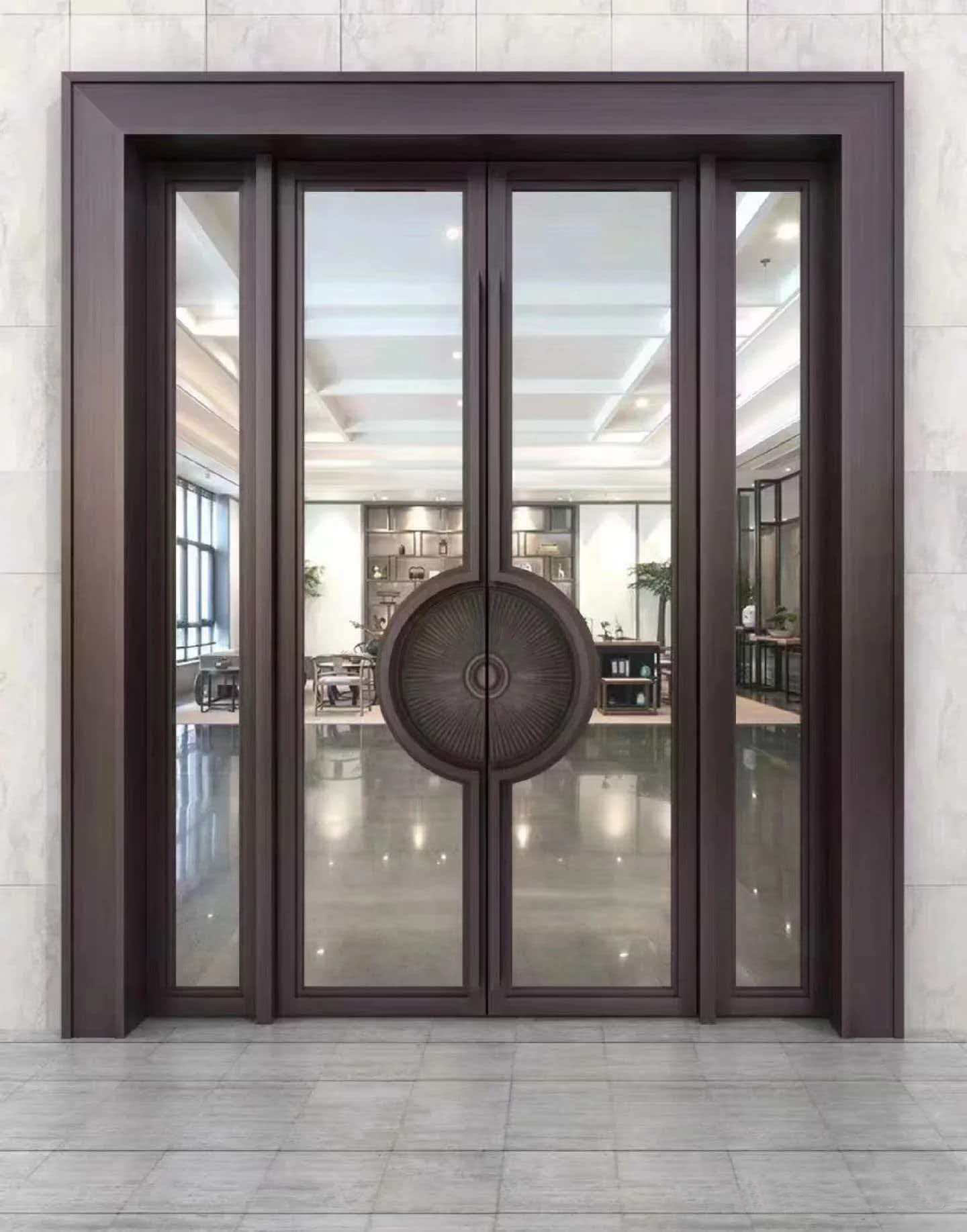
Engineering the Invisible: The Structural Marvel of Modern Luxury Pivot Doors
In the realm of architectural statement pieces, few elements command presence like a properly executed pivot door. These monumental portals—often spanning 8 feet in height and 5 feet in width—represent not just aesthetic ambition but a profound engineering challenge. As Chief Engineer at Kingston Doors, I’m often asked: “How does something so massive swing so effortlessly, and remain perfectly aligned for decades?” The answer lies not in the visible door slab, but in the hidden skeletal system that bears its entire weight: the pivot hinge assembly.
The Physics of Pivotal Moments
Unlike traditional butt hinges that distribute load along the door’s edge, a pivot hinge transfers the entire door weight—often 400 to 600 pounds for solid wood or glass-composite designs—through a single, vertical axis. This creates a rotational moment that must be perfectly balanced. The pivot point is typically located 4 to 6 inches from the door edge, creating a lever arm that magnifies both mechanical advantage and potential stress.
Anatomy of a Heavy-Duty Pivot Hinge
Our flagship pivot system, the K-9000 Series, exemplifies the engineering required. Let’s examine its components:
1. Upper Pivot Assembly
Machined from 4140 chromoly steel, the upper pivot houses a tapered roller bearing with a dynamic load rating of 1,200 pounds. This bearing accommodates both radial loads (door weight) and axial loads (lateral forces). The housing is engineered with 0.002-inch clearance tolerance to prevent play while allowing thermal expansion.
2. Lower Pivot Assembly
The true workhorse. This floor-mounted unit contains:
– A thrust bearing rated for 2,000 pounds vertical load
– A self-lubricating bronze bushing for rotation
– A 1/2-inch diameter stainless steel pivot pin, hardened to 50 HRC
– An integrated leveling plate with ±1/4 inch vertical adjustment
3. Structural Integration
The pivot system doesn’t merely attach to the door; it becomes part of its structure. We engineer a 3/16-inch steel reinforcement plate that runs the full height of the door’s pivot edge, distributing stress across 96 inches rather than concentrating it at fastener points. This plate is bonded to the door core with aerospace-grade epoxy, creating a monolithic load path.
Load Calculations & Safety Factors
For a typical 5′ x 8′ door in mahogany (density: 40 lbs/ft³):
Weight: 5.83 ft³ × 40 lbs/ft³ = 233 lbs
Hardware & Glass Additions: +100 lbs
Total Dead Load: ≈ 333 lbs
Dynamic Load Factor (user force): 1.5×
Design Load: 500 lbs
Safety Factor (industry standard): 5×
System Rating: 2,500 lbs minimum
Our K-9000 Series is rated for 3,000 lbs—a 20% margin beyond even conservative engineering standards.
Smart Lock Integration: Structural Considerations
Integrating smart locks introduces unique challenges. A typical mortise-style smart lock requires a 1-inch deep × 4-inch high pocket in the door edge. This removal of material creates a potential weak point in our carefully engineered stress distribution.
Our solution: The reinforcement plate mentioned earlier is specifically designed with a pre-engineered “lock pocket” that maintains continuous load paths around the cavity. We use finite element analysis (FEA) to model stress concentrations and add localized reinforcement—often a 1/4-inch steel doubler plate—around the lock cavity perimeter.
Installation Precision: The 1/32-Inch World
Pivot doors live or die by installation precision. Our systems provide:
- Vertical Adjustment: ±3/8 inch via threaded lower assembly
- Lateral Adjustment: ±1/4 inch via slotted mounting holes
- Depth Adjustment: ±1/8 inch via shim system
- Plumb Tolerance: 1/32 inch per foot of height
This adjustability accommodates real-world conditions: foundation settling (up to 1/2 inch in 10 years), frame shrinkage in timber construction, and even seismic zone requirements.
Long-Term Performance: Materials Science in Action
Beyond initial installation, we engineer for decades of service. The pivot pin undergoes a QPQ (quench-polish-quench) salt bath nitride treatment, creating a 0.001-inch deep wear surface with 70 HRC hardness—harder than most industrial drill bits. The bronze bushing is impregnated with PTFE, providing lubrication for approximately 100,000 cycles (about 30 years of normal use).
We conduct accelerated life testing simulating 50 years of operation: 200,000 open-close cycles under load, temperature cycling from -20°F to 120°F, and salt spray corrosion testing equivalent to 20 years in coastal environments.
Conclusion: Engineering as Art
The luxury pivot door represents that rare intersection where architectural beauty is entirely dependent on engineering excellence. What appears as a simple, massive slab floating effortlessly on its axis is actually a precisely calculated system of levers, bearings, and materials working in silent harmony. At Kingston, we believe the true luxury isn’t just in the visible aesthetics, but in the invisible confidence that comes from engineering that never asks for attention—only admiration.
Jonathan Thorne has been designing architectural door systems for 25 years, holding seven patents in hinge and hardware technology. When not in the engineering lab, he can be found restoring mid-century modern homes.