

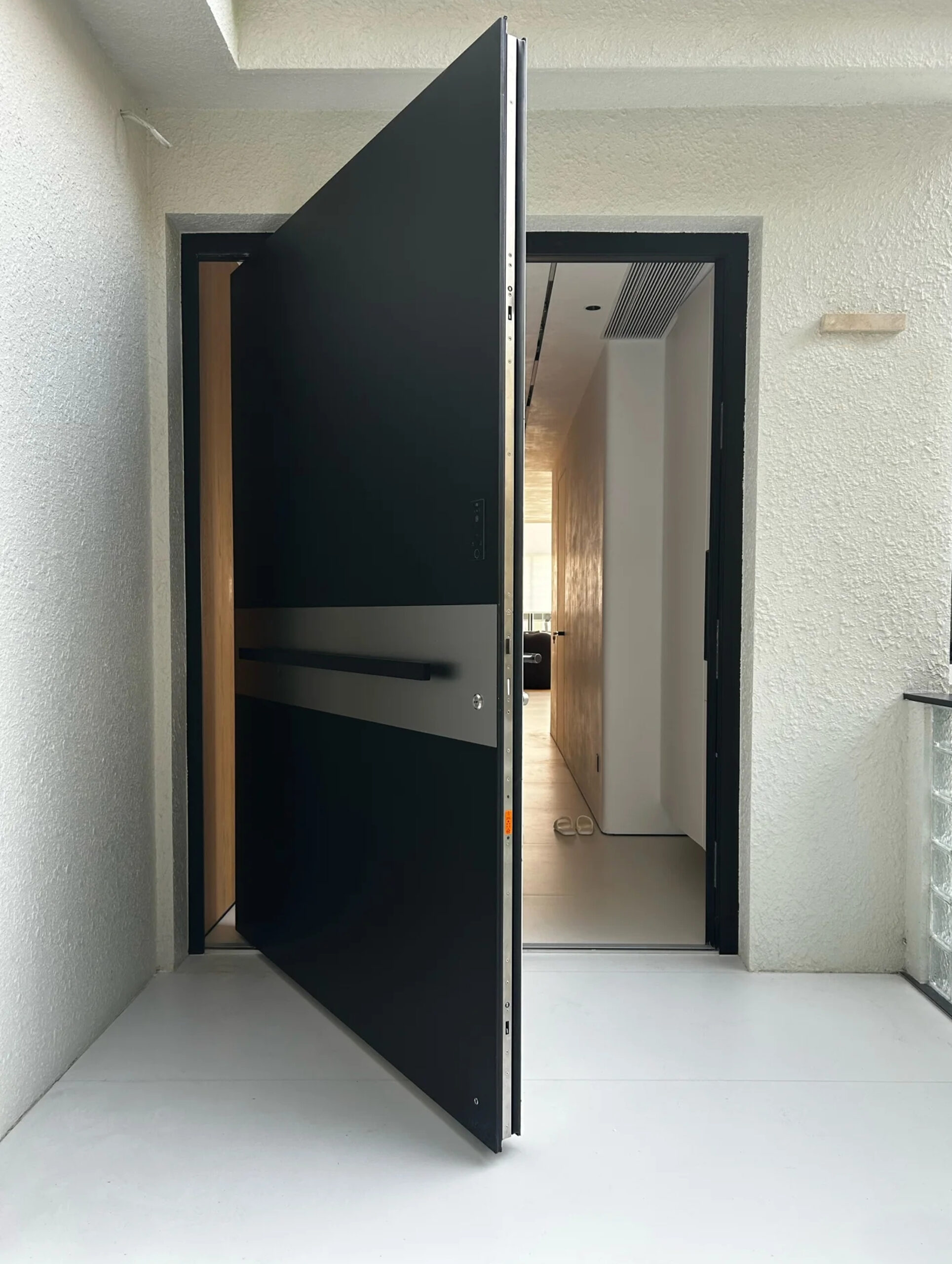
Engineering Excellence: The Structural Dynamics of Premium American Pivot Door Systems
As Chief Engineer at Kingston Doors, I’m often asked what separates a luxury pivot door from standard swinging doors. The answer lies not in aesthetics, but in structural engineering principles that ensure decades of flawless operation. This technical deep-dive explores the engineering behind our American-made pivot door systems.
1. Pivot Point Mechanics: The Foundation of Stability
Unlike traditional hinge doors that distribute weight across multiple points, Pivot Doors rotate on a single vertical axis. This creates unique engineering challenges:
Load Distribution Analysis
Our pivot systems are engineered to handle doors weighing up to 1,200 pounds with a safety factor of 3:1. The pivot point must withstand:
- Vertical load: 1,200 lbs (door weight)
- Horizontal load: 300 lbs (wind pressure at 90 mph)
- Moment force: 4,500 lb-in at maximum lever arm
The pivot assembly consists of three critical components:
- Upper Pivot Bearing: Precision-machined from 316 stainless steel with a load rating of 2,500 lbs
- Lower Load Bearing: Double-row angular contact ball bearings rated for 3,000 lbs axial load
- Structural Mounting Plate: 1/2-inch thick steel plate with 3/4-inch anchor bolts into structural framing
2. Frame Integration: Structural Interface Engineering
Proper installation requires understanding the load path from door to building structure:
| Door Size | Required Header | Minimum Wall Thickness | Anchor Bolt Pattern |
|---|---|---|---|
| 8 ft × 4 ft | Triple 2×12 LVL | 6 inches | 6 bolts (3 top, 3 bottom) |
| 10 ft × 5 ft | Quad 2×14 LVL | 8 inches | 8 bolts (4 top, 4 bottom) |
The mounting system transfers loads directly to the building’s structural elements, bypassing drywall and non-load-bearing components. Our engineering specifications require:
Structural Verification Requirements
- Concrete foundation: Minimum 3,000 psi compressive strength
- Wood framing: #2 grade or better Douglas Fir or Southern Yellow Pine
- Steel framing: Minimum 12-gauge studs at 16-inch centers
- Deflection limit: L/360 under full design load
3. Dynamic Performance: Engineering for Real-World Conditions
Pivot doors must perform consistently across environmental variables:
Thermal Expansion Management
Solid wood doors expand and contract with humidity changes. Our engineering accounts for:
- Expansion gap: 1/8 inch per 3 feet of door width
- Thermal break: 0.25-inch polyamide barrier in aluminum frames
- Moisture content: Engineered to 6-8% equilibrium moisture content
Wind Load Engineering
For coastal or high-wind areas, our systems are tested to:
- Positive pressure: 40 psf (130 mph wind speed)
- Negative pressure: -30 psf
- Cyclic loading: 5,000 cycles at design load
4. Precision Manufacturing: Tolerances and Quality Control
Every Kingston pivot system is manufactured to aerospace-grade tolerances:
Critical Manufacturing Tolerances
- Pivot bore diameter: ±0.0005 inches
- Bearing surface flatness: 0.001 inches per 12 inches
- Mounting plate parallelism: ±0.002 inches
- Hardness: Rockwell C 58-62 for bearing surfaces
Each component undergoes:
- Dimensional verification via coordinate measuring machine (CMM)
- Material certification per ASTM standards
- Load testing to 150% of design capacity
- Cycle testing: 250,000 open-close cycles minimum
5. Installation Engineering: The Final Critical Phase
Even perfect engineering can fail with improper installation. Our installation protocol requires:
Plumb and Level Requirements
- Frame plumb: ±1/16 inch in 8 feet
- Floor level: ±1/8 inch in 10 feet
- Header level: ±1/32 inch across opening
Load Verification Procedure
Post-installation verification includes:
- Torque check: All fasteners to specified values (45-50 ft-lbs)
- Rotation test: Smooth 180° rotation with ≤5 lbs of force
- Gap consistency: 1/8 inch uniform gap around perimeter
- Load test: Application of 150 lbs horizontal force at handle height
Conclusion: Engineering as the Foundation of Luxury
The elegance of a pivot door is ultimately supported by rigorous engineering. At Kingston Doors, we believe true luxury isn’t just about appearance—it’s about engineering integrity that ensures decades of flawless performance. Every pivot system represents thousands of hours of engineering analysis, material science, and precision manufacturing, all focused on one goal: creating doors that don’t just look impressive, but perform impeccably for generations.
— Johnathan Wright, Chief Engineer, Kingston Doors Engineering Division