
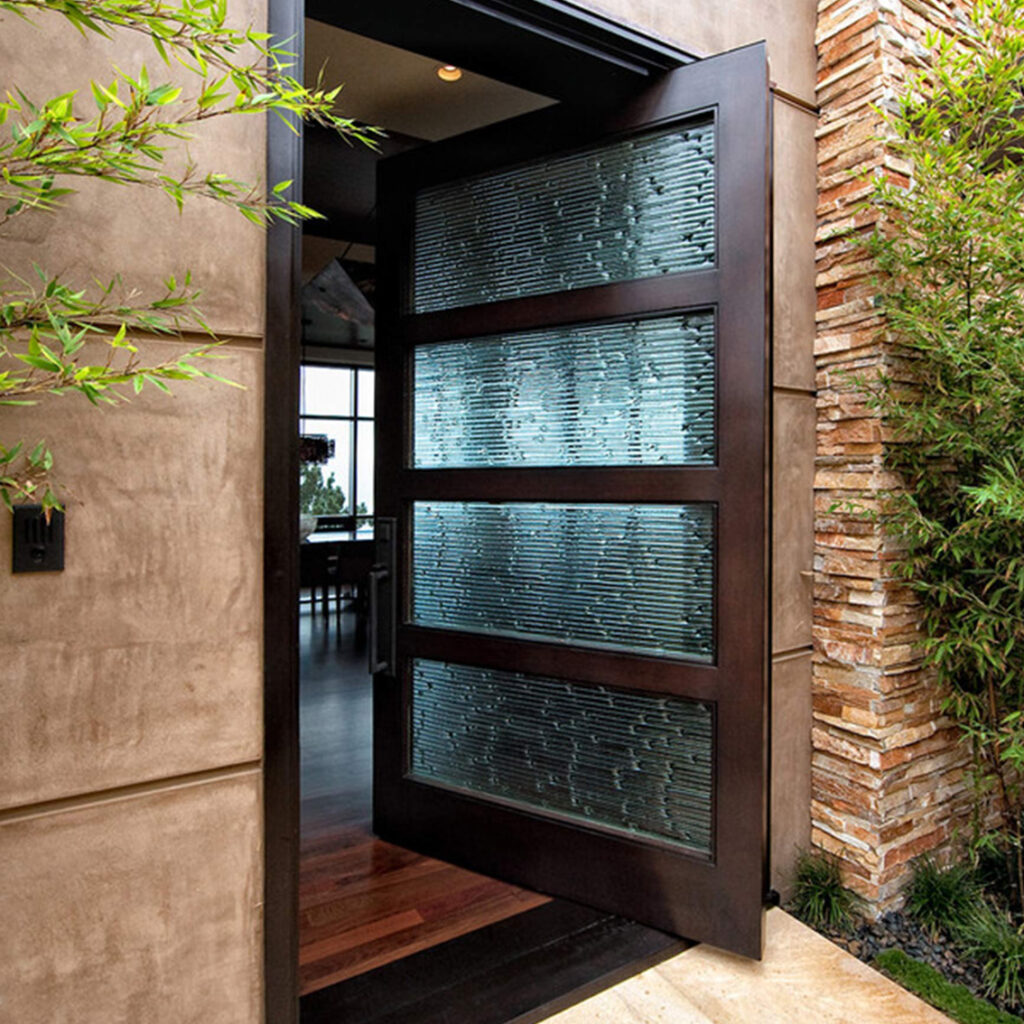

Engineering Excellence: The Technical Mastery Behind Custom Oversized Pivot Doors with Bronze Finishes
As Chief Engineer at Kingston Doors, I’m often asked about the technical challenges and solutions involved in creating custom oversized pivot doors, especially those with premium finishes like bronze. These doors represent the pinnacle of architectural hardware, blending aesthetic vision with rigorous engineering principles. In this technical deep dive, I’ll explore the critical engineering details that make these doors not just beautiful, but structurally sound and functionally superior.
The Pivot Hinge System: Heart of the Operation
At the core of every pivot door is the pivot hinge system, which differs fundamentally from traditional hinge mechanisms. While standard hinges mount to the door frame and door edge, pivot hinges anchor at the top and bottom of the door, allowing it to rotate around a central vertical axis. This creates the signature smooth, weightless swing that defines luxury pivot doors.
For oversized doors—typically those exceeding 8 feet in height or 4 feet in width—the engineering demands escalate dramatically. Our standard pivot systems handle doors up to 600 pounds, but custom oversized doors can approach 1,000 pounds or more. This requires specialized heavy-duty pivot mechanisms with reinforced steel components, precision bearings, and advanced load distribution systems.
Top Pivot Assembly
The top pivot carries approximately 60% of the door’s weight and handles most of the rotational forces. Our engineering team specifies high-grade stainless steel pivot pins with diameters ranging from 1.5 to 2.5 inches for oversized applications. These pins rotate within sealed ball bearings rated for continuous heavy loads, with load capacities carefully calculated using the formula:
L = (W × H) / (2 × d)
Where L is the bearing load, W is door weight, H is height, and d is the distance from pivot to door edge. For a 900-pound, 10-foot door, this calculation ensures we select bearings with at least 20% safety margin above expected loads.
Bottom Pivot Assembly
The bottom pivot serves as both a rotational point and a vertical support. Our designs incorporate adjustable floor plates that allow for precise leveling during installation—critical for preventing door sag over time. The bottom pivot typically features a thrust bearing to handle vertical loads while allowing smooth rotation. For extra-heavy doors, we implement dual-bearing systems that distribute weight across multiple contact points.
Concealed vs. Exposed Pivots
Engineering decisions extend to aesthetic considerations. Concealed pivot systems hide all mechanical components within the door and frame, creating a clean, minimalist appearance. These require precise machining of internal channels and careful alignment during installation. Exposed pivot systems showcase the hardware as a design feature, often with custom finishes like bronze to match the door. Both approaches demand different engineering solutions for load transfer and alignment.
Structural Engineering for Oversized Doors
Custom oversized doors present unique structural challenges that go beyond standard door engineering. The increased surface area creates greater wind load pressures, while the extended dimensions amplify any material weaknesses.
Frame Reinforcement
We engineer door frames with reinforced steel cores for doors exceeding standard dimensions. The frame cross-section increases proportionally to door size, with additional internal bracing at stress points. Finite element analysis (FEA) software helps us model stress distribution and identify potential failure points before fabrication begins.
Material Selection and Thickness
While bronze finishes provide the aesthetic, the underlying materials determine structural integrity. We typically use:
- Solid wood cores: Laminated from multiple layers with alternating grain directions to prevent warping
- Steel reinforcement: Strategic placement of steel plates within the door structure
- Composite materials: For glass pivot doors, we use laminated safety glass with interlayers that provide both strength and security
Material thickness increases with door size, but not linearly. Our calculations account for the cube-square law—as doors grow in two dimensions, their weight increases cubically while cross-sectional strength increases only quadratically. This requires careful engineering to maintain proper strength-to-weight ratios.
Wind Load Calculations
For exterior applications, wind load becomes a critical factor. We calculate expected wind pressures using the formula:
P = 0.00256 × V² × Kz × Kzt × Kd
Where P is wind pressure in psf, V is wind speed, and the K factors account for exposure, topography, and directionality. For a 10-foot door in a 90 mph wind zone, this can result in pressures exceeding 40 psf—forces that must be resisted by both the door structure and pivot system.
Bronze Finishes: More Than Just Surface Treatment
The bronze finish on custom pivot doors represents a sophisticated intersection of metallurgy and aesthetics. True bronze—an alloy of copper and tin—offers exceptional durability and a distinctive patina that develops beautifully over time.
Finishing Process
Our bronze finishing process involves multiple stages:
- Surface preparation: Mechanical abrasion creates the ideal surface for adhesion
- Base coating: Electroplating or PVD (Physical Vapor Deposition) applies a consistent bronze layer
- Patina development: Controlled chemical processes accelerate natural oxidation
- Protective sealing: Clear ceramic coatings protect the finish while maintaining appearance
For pivot hardware, we use solid bronze or bronze-plated stainless steel to ensure both aesthetic consistency and mechanical strength.
Thermal Considerations
Bronze has different thermal expansion properties than underlying materials like steel or wood. We account for this in our engineering by:
- Allowing for differential expansion in mounting systems
- Using flexible adhesives in laminated constructions
- Designing pivot connections with thermal movement accommodation
Corrosion Protection
While bronze naturally resists corrosion, additional protection is essential for exterior applications. Our engineering specifies:
- Cathodic protection systems for dissimilar metal contacts
- Barrier coatings between bronze and other metals
- Regular maintenance protocols to preserve the finish
Installation Engineering
The installation of custom oversized pivot doors requires precise engineering from start to finish. Even the most perfectly engineered door will fail if installed incorrectly.
Load Path Design
We engineer complete load paths that transfer door weight and operational forces through the pivot system into the building structure. This often requires:
- Structural reinforcement of door openings
- Custom steel lintels above openings
- Reinforced concrete footings below floor pivots
Alignment Systems
Oversized doors require precise alignment to function properly. Our engineering includes:
- Laser alignment systems during installation
- Adjustable pivot mounts with micron-level precision
- Thermal expansion compensation in alignment settings
Testing and Commissioning
Before installation, every custom oversized pivot door undergoes rigorous testing:
- Cycle testing: 100,000 open-close cycles minimum
- Load testing: 150% of design load for 24 hours
- Environmental testing: Temperature extremes and humidity cycling
- Finish testing: Salt spray and UV exposure for exterior applications
Innovations in Pivot Door Engineering
At Kingston Doors, we’re constantly advancing pivot door technology. Recent innovations include:
- Smart pivot systems: Integrated sensors monitor bearing wear and alignment
- Hybrid pivot-concealed hinge systems: Combining the best features of both technologies
- Advanced materials: Carbon fiber reinforcement for ultra-light yet strong doors
- Automated adjustment systems: Self-leveling pivots that compensate for building settlement
The engineering behind custom oversized pivot doors with bronze finishes represents a perfect marriage of form and function. From the precision mechanics of pivot hinges to the material science of bronze finishes, every element requires careful engineering consideration. At Kingston Doors, we approach each project as a unique engineering challenge, applying principles of structural mechanics, materials science, and precision manufacturing to create doors that are as technically excellent as they are beautiful.
When specifying custom oversized pivot doors, look beyond the surface aesthetics. The true quality lies in the engineering details—the pivot systems that bear immense loads, the structural reinforcements that prevent deflection, and the finishing processes that ensure lasting beauty. These technical elements separate exceptional doors from merely expensive ones.