
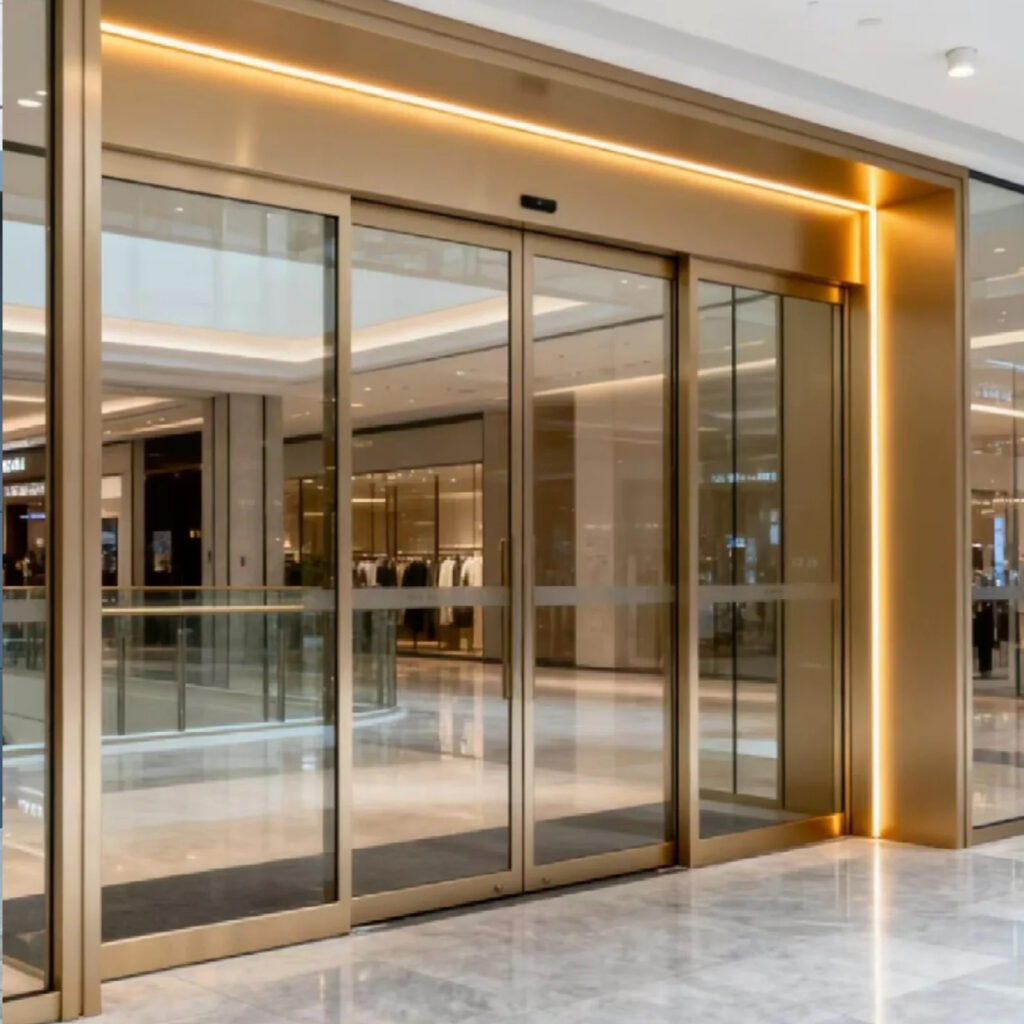
WHY ARCHITECTS ARE WRONG ABOUT SLIDING DOORS
Design Ends at Completion. Performance Begins After.
Sliding doors have become a default choice in modern commercial and residential architecture. Clean lines, transparent façades, and space-saving operation make them visually appealing and easy to justify during the design phase.
Yet in real-world projects, sliding doors are often one of the most problematic components after handover.
This contradiction is not caused by poor products or installation errors.
It is caused by a fundamental misunderstanding of what sliding doors actually are.
Sliding Doors Are Not Architectural Features — They Are Traffic Systems
Architectural drawings prioritize proportion, symmetry, and visual continuity. Sliding doors fit naturally into this logic. They align with façades, preserve openness, and minimize visual interruption.
But once a building opens, doors stop being visual elements. They become traffic systems.
They must respond to unpredictable human behavior: hesitation, sudden stops, carts, luggage, children, and peak-hour congestion. None of these realities exist on drawings, yet all of them define performance.
When a door is designed only to look correct, it will eventually behave incorrectly.
The Hidden Assumption Behind Most Sliding Door Designs
Many projects apply a standard sliding-door solution to fundamentally different entrance scenarios.
High-end retail entrances require smooth flow and subtle timing.
Hospitals and airports demand redundancy and absolute reliability.
Large public buildings require scalability and emergency clearance.
Treating these entrances as equivalent problems leads to predictable outcomes: delayed response, increased wear, frequent service calls, and frustrated users.
These failures are rarely immediate. They appear gradually, often years after completion—when responsibility has already shifted away from the design stage.
Bigger Openings Reveal Structural Limits
As architectural trends favor wider openings and heavier glass, the physical limits of traditional sliding-door structures become more apparent.
Inconsistent movement, sensor misjudgment, and accelerated component fatigue are not installation defects. They are the result of systems operating beyond the assumptions they were designed for.
What looks efficient on paper often becomes expensive in operation.
A Sliding Door Is a System, Not a Product
A common misconception is that sliding doors are finished products selected from catalogs. In reality, long-term performance depends on how the system integrates with the building.
Key factors include:
- Structural alignment and installation tolerance
- Long-term floor settlement and building movement
- Load distribution across moving components
- Sensor logic calibrated to real traffic behavior
Ignoring these variables does not eliminate them. It simply delays their consequences.
The Highest Standard Is Invisible Performance
The most successful sliding doors share one characteristic: users do not notice them.
There is no hesitation, no confusion, no interruption of movement. The door opens at the right moment, closes without drama, and disappears into the architecture.
When people notice a door, something has already failed.
Technical Considerations That Define Long-Term Performance
At Kingstons, sliding door systems are specified from an engineering perspective rather than a catalog perspective. Performance is evaluated based on long-term behavior, not initial appearance.
Typical criteria include:
- Load capacity versus opening width
Structural calculations are based on actual glass weight and clear opening size, not nominal dimensions. - Operational cycle durability
Critical components are selected to maintain stable motion after tens of thousands of cycles. - Accommodation for structural settlement
Door systems must tolerate long-term building movement without degradation. - Sensor response logic
Detection zones and response timing are calibrated according to how people actually move—not default factory settings. - Maintenance accessibility
A system that cannot be serviced efficiently will not perform reliably over time.
These parameters are rarely visible on architectural drawings, but they ultimately determine whether an entrance continues to function quietly, year after year.
Designed for Use, Not for Drawings
Architectural design concludes when construction is complete.
Entrance performance begins the moment the building opens to the public.
Sliding doors are not successful because they look correct on opening day. They are successful when they continue to operate naturally, reliably, and unnoticed years later.
At Kingstons, we don’t design doors for drawings.
We design entrance systems for long-term use.
Because a sliding door is not successful when it looks right.
It is successful when no one notices it at all.
Call to Action
Discuss Your Entrance Requirements
Speak with our technical team about traffic flow, opening size, and long-term performance considerations.