
Last week, a project manager sent me a frantic message at 10 PM. They had installed a custom entry door three months ago, and now the bottom seal was shredding the expensive marble flooring. “The drawings looked perfect,” he argued.
That is exactly the problem. In my 10 years working with high-end door systems, I see this scenario play out on luxury sites from California to Dubai. Architects draw lines; we have to deal with gravity and wind loads.
Today, I’m not here to sell you a product. I’m here to tell you the uncomfortable truth about choosing entry door that most catalogs won’t mention: Structural Integrity vs. Aesthetic Ego.
The “Slim Frame” Obsession: A Structural Time Bomb
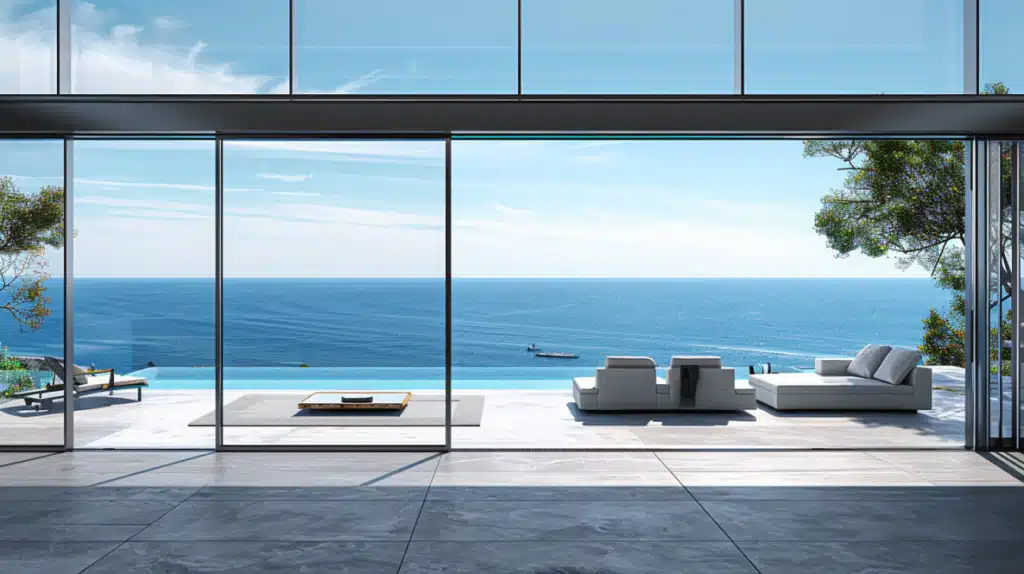
Every designer today wants the “invisible frame” look. I get it, it looks stunning in renders. But let’s talk about physics. When you specify a entry door that exceeds 3 meters in height, the lateral wind load is enormous.
I often see specifications using standard aluminum profiles for these oversized openings. It works for the first year. But aluminum has memory. Over time, with repeated thermal expansion and wind pressure, “slim” profiles start to bow. It’s microscopic at first, but soon your locking points drift by 2mm. That’s all it takes for a high-end door to feel like a cheap gate.
My advice? If you want to go big with entry door, stop obsessing over the 20mm face width. Accept a robust 50mm reinforced sash. You are trading a tiny visual detail for twenty years of smooth operation. It’s a trade-off that separates a functional home from a showroom piece.
The “Zero Threshold” Lie
Let’s talk about the floor. Everyone demands a flush threshold—seamless transition from indoor to outdoor. With entry door, this is the most dangerous request you can make without proper preparation.
I’ve seen contractors pour concrete without accounting for the sub-sill drainage required for a true flush entry door. They assume the door seal will stop the water. It won’t. In a typhoon or heavy storm, water pressure laughs at rubber seals.
If you insist on a zero-threshold design, we need to talk about what’s happening under the tiles. We need a concealed drainage channel with at least twice the capacity of a standard system. If the site conditions don’t allow for deep excavation, do not force a flush threshold. A 15mm weather stop might ruin your “perfectly flat” aesthetic, but it will save you from replacing your wood floors next monsoon season.
Hardware: Where the Budget Should Actually Go
A entry door is only as good as its weakest pivot or roller. I recently inspected a villa where the owner complained the door was “heavy.” It wasn’t heavy; the bearing was crushed. They saved $500 on the hardware package on a $20,000 door.
For entry door, the dynamic load is very different from static weight. You need hardware that offers 3D adjustability after installation. Buildings settle. Concrete moves. If your hardware is fixed, you have zero tolerance for reality.
The Final Call
We can manufacture anything you draw. If you want a 4-meter high, ultra-slim entry door with no threshold, we can build it. But the question isn’t “Can we build it?”
The question is: Are you designing for the photo shoot on day one, or for the homeowner who has to open that door ten years from now?
Think about it.