
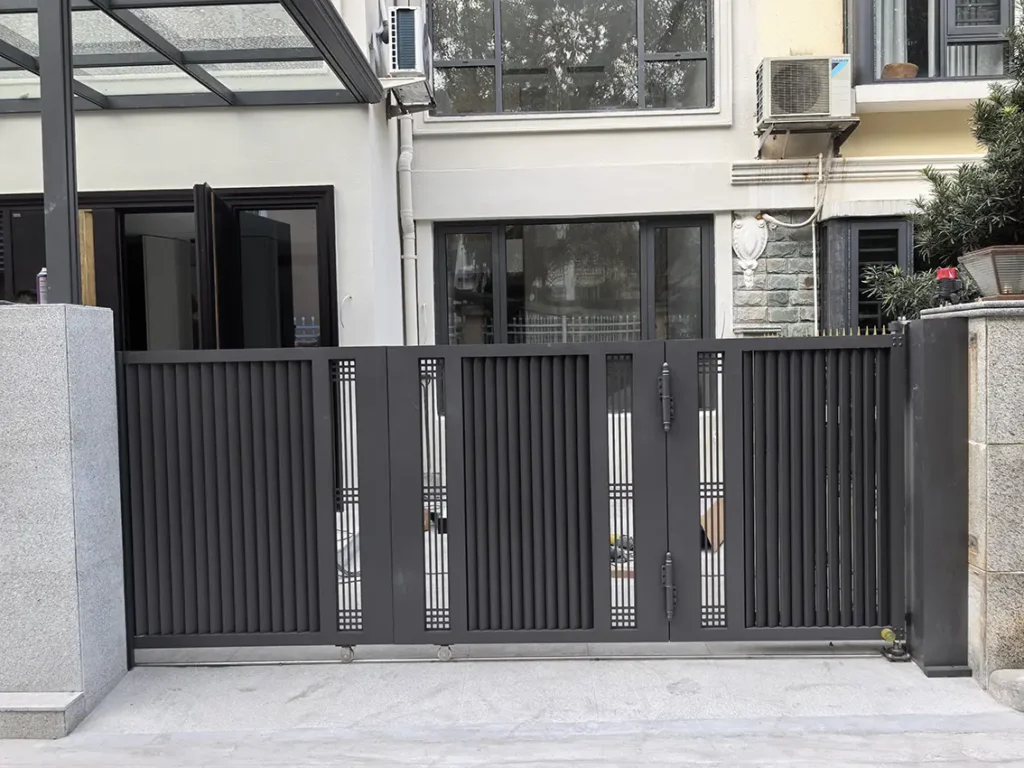

The Science of Smooth Motion: Solving the 'Deadlock' and 'Stack Width' in 3-Leaf Folding Gates
At Kingston Doors, we specialize in high-security entrance solutions where engineering meets aesthetics. A recent project featuring a 3-leaf telescopic folding gate highlighted two of the most significant challenges in gate automation and manual operation: the “Mechanical Deadlock” and excessive “Stacking Width.”
When dealing with premium 60mm thick panels, standard off-the-shelf hardware often fails. Here is how we engineered a solution for a system with unequal leaf widths (Lead leaf: 1130mm; Trailing leaves: 1340mm).
1. Breaking the “Mechanical Deadlock”
A common failure in 3-leaf systems occurs when the gate is fully closed. If the first and second leaves align in a perfect $180^{\circ}$ line, the system enters a “deadlock”. In this state, the pulling force is parallel to the hinges, resulting in zero torque—making the gate feel “stuck” to the user.
The Kingston Solution: We recalculated the guide wheel position on the third leaf. By shifting the wheel from the theoretical 242.5mm to a calibrated 227.5mm from the hinge center, we force the leaves to maintain a slight “V-angle” even when fully extended. This tiny geometric offset ensures immediate leverage the moment the gate is pulled.
2. From 600mm to 300mm: Optimizing the Stack
Thick panels (60mm) naturally resist tight folding. In a standard setup, the inner edges of the panels collide, creating a $15^{\circ}$ gap that results in a bulky 600mm stack width , obstructing nearly half a meter of driveway space.
The Kingston Solution: Synchronous Linkage
To achieve a compact, parallel fold, we implement a Mechanical Linkage System:
-
Forced Alignment: A top-mounted rod forces the second and third leaves to overcome the $60\text{mm}$ thickness interference, pulling them into a tight, parallel stack.
-
Variable Ratio Compensation: Since our lead leaf is shorter ($1130\text{mm}$) than the trailing leaves ($1340\text{mm}$), we utilize a 1.1:1 transmission logic within the linkage. This ensures the wider trailing leaves “catch up” during the folding cycle, reducing the stack width from nearly $600\text{mm}$ down to approximately 260mm–300mm.
3. Engineering for Durability
For a gate to remain a “Kingston,” every component must handle the high torque of $1340\text{mm}$ wide panels. We utilize:
-
Heavy-Duty Pivots: Designed to support the weight of $60\text{mm}$ thick aluminum or copper systems.
-
Precision Bearings: Ensuring that the linkage operates silently and requires minimal maintenance over thousands of cycles.
Conclusion
The difference between a gate that “works” and a gate that “glides” is found in the millimeters. By mastering the physics of leverage and synchronization, Kingston Doors delivers high-security entrances that never compromise on driveway clearance or ease of use.
Planning a high-security entrance with limited space? Contact our engineering team for a customized CAD layout for your next projec