
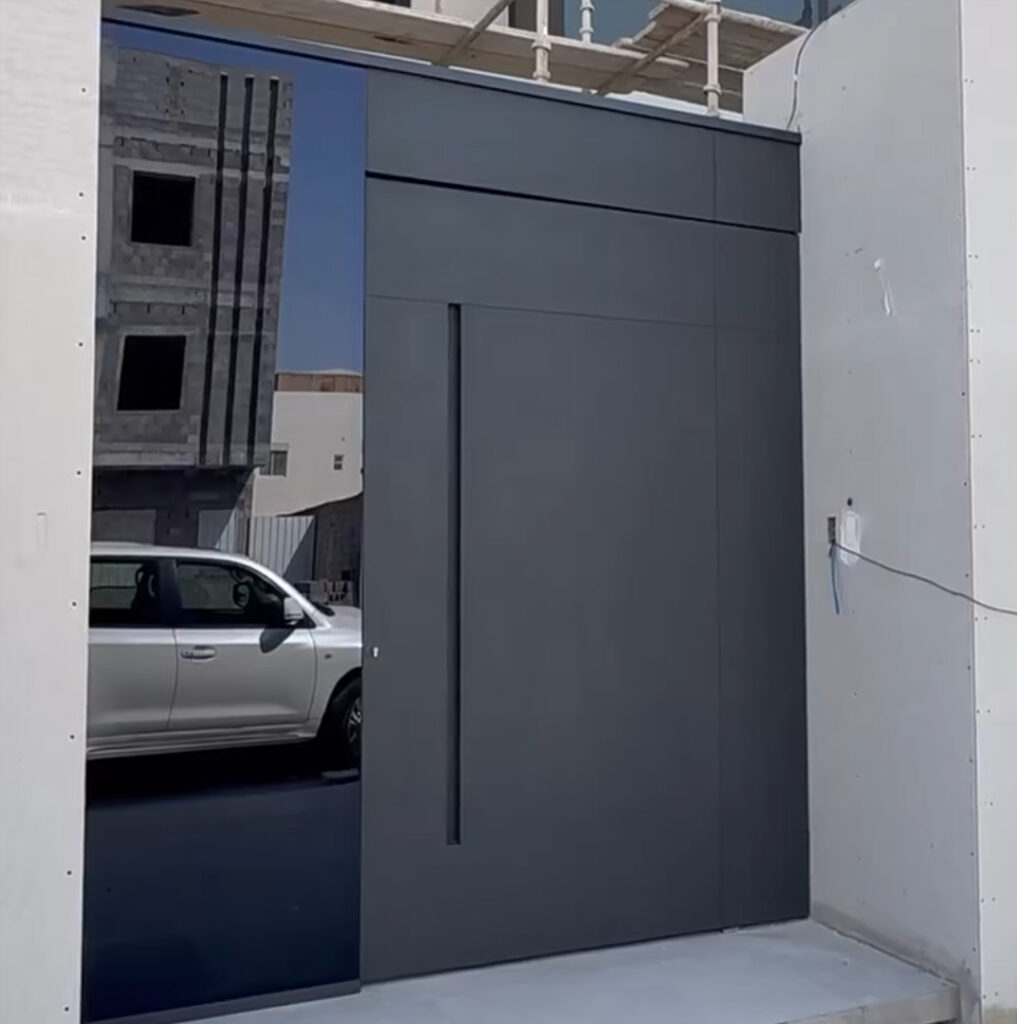
# The Pivotal Revolution: Mastering the Art and Engineering of Modern Pivot Doors
In the world of architectural hardware, few elements make as bold a statement as the pivot door. More than just an entryway, a properly executed pivot door is a kinetic sculpture, an engineering marvel, and a defining architectural feature all in one. As senior door engineers, we understand that specifying and installing these systems requires moving beyond basic hardware knowledge into the realm of structural engineering, architectural vision, and precision craftsmanship.
## The Fundamental Principle: Redefining Door Mechanics
Unlike traditional hinged doors that rotate on a vertical axis at their edge, pivot doors rotate on a vertical axis set away from the door edge—typically 4-6 inches from the jamb. This fundamental shift in mechanics creates several distinctive advantages:
**Structural Superiority**: Pivot hardware distributes weight along the vertical axis rather than concentrating stress at hinge points. This allows for significantly larger, heavier doors—often exceeding 500 pounds—without sagging or binding. The pivot point becomes a true rotational bearing, handling immense loads with graceful efficiency.
**Seamless Aesthetics**: With minimal visible hardware and the ability to create nearly invisible gaps between door and frame, pivot systems achieve the clean, minimalist lines that define contemporary architecture. The door appears to float, creating dramatic visual impact.
**Enhanced Performance**: Properly engineered pivot systems offer smoother operation throughout their lifecycle, with wear distributed across larger bearing surfaces rather than concentrated at small hinge knuckles.
## Engineering Considerations: The Hidden Complexity
### Load Calculations and Structural Requirements
Every pivot door project begins with physics. We calculate:
– **Dead load**: Weight of the door material (glass, wood, metal, or composites)
– **Live load**: Anticipated forces from operation and environmental factors
– **Moment forces**: Rotational forces that increase with door width
– **Foundation requirements**: Transferring these loads to the building structure
A common misconception is that pivot doors require less structural support. In reality, they demand more sophisticated load transfer—typically requiring reinforced headers, specialized floor boxes, or structural steel supports integrated during the building’s framing stage.
### Hardware Selection: Beyond the Pivot
The pivot mechanism itself is just the beginning. A complete system includes:
1. **Top Pivot Assembly**: The primary load-bearing component, often featuring adjustable tension mechanisms and integrated dampers for controlled closing.
2. **Bottom Pivot Assembly**: Handles vertical loads while allowing rotation, frequently incorporating automatic threshold lifts for barrier-free transitions.
3. **Concealed Closers**: Integrated into the frame or header for invisible operation.
4. **Coordinated Hardware**: Specialized pulls, strikes, and seals designed for the unique geometry of pivot doors.
### Material Science Applications
Modern pivot doors push material boundaries:
– **Laminated glass assemblies** reaching 15+ feet with minimal framing
– **Solid wood slabs** up to 6 inches thick, requiring moisture-stable engineering
– **Metal composites** with integrated insulation and structural cores
– **Hybrid systems** combining materials for optimal performance
## Installation Precision: The 1mm Standard
Where standard doors might tolerate 3-5mm tolerances, pivot systems demand sub-1mm precision. Our installation protocol includes:
**Three-Stage Alignment**:
1. Structural verification of rough openings (plumb, level, and square within 1.5mm over 3 meters)
2. Frame and pivot point installation with laser alignment
3. Door hanging and fine adjustment using micrometer-grade hardware
**Dynamic Testing**: We simulate decades of use through accelerated cycling, verifying that the door will maintain its precision alignment under real-world conditions.
## Thermal and Acoustic Performance
Contrary to assumptions about large single-panel doors, modern pivot systems can achieve exceptional performance:
– **U-values as low as 0.15 W/m²K** through thermally broken frames and triple-glazed assemblies
– **Sound transmission class ratings up to STC 45** using laminated glass, acoustic seals, and mass-loaded components
– **Pressure equalization systems** that maintain performance in high-wind environments
## The Future of Pivot Technology
**Smart Integration**: Next-generation systems incorporate:
– Invisible RFID or biometric access controls
– Motorized operation with position memory
– Integrated sensors for climate control and security
– Self-diagnostic hardware that alerts to maintenance needs
**Sustainable Engineering**: We’re developing carbon-negative pivot systems using engineered bamboo, recycled aluminum, and glass with embedded photovoltaic cells.
**Adaptive Geometry**: Experimental systems with variable pivot points that change the door’s rotational characteristics based on usage patterns.
## Common Pitfalls and Professional Solutions
**Mistake**: Treating pivot doors as “upscale hinges”
**Solution**: Engage structural engineers during schematic design, not after framing
**Mistake**: Selecting hardware based on price rather than calculated load ratings
**Solution**: Always specify hardware with 2.5x safety factor over calculated loads
**Mistake**: Improper sequencing with other trades
**Solution**: Develop integrated installation schedules that coordinate with flooring, finishes, and structural work
## The Pivot Door as Architectural Statement
Beyond technical considerations, the most successful pivot doors achieve something transcendent—they become the focal point of a space while disappearing into the architecture. They guide movement, frame views, and create moments of drama in daily passage.
When clients ask if pivot doors are worth the investment, we explain that they’re not buying a door; they’re investing in architectural theater, engineering excellence, and daily tactile pleasure. A properly engineered pivot door doesn’t just open—it performs.
In our practice, we’ve moved beyond thinking of these as mere doors. They’re kinetic installations that happen to provide passage. And in that distinction lies both the challenge and the reward of our craft.
—
*Senior Door Engineering Perspective: Always remember that the most beautiful pivot door is only as good as its engineering. The invisible hardware matters as much as the visible design. Specify with precision, install with patience, and engineer for generations—not just for today’s aesthetic trends.*