
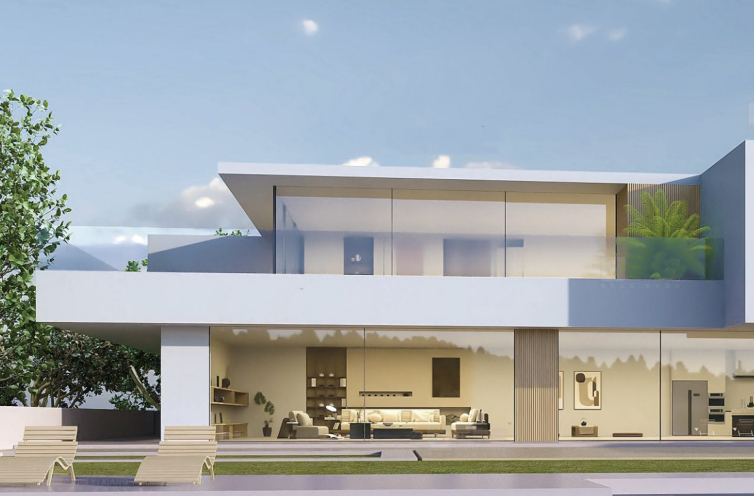
When a 12-Meter Glazed Wall is Not a Window, But a Structural Element
The defining challenge of a luxury aluminum folding door system is not aesthetics—it is structural physics. You are not installing a door; you are replacing a load-bearing wall with a moving, multi-panel assembly that must resist wind loads, manage its own dead weight, and maintain a thermal break, all while operating with millimetric precision. The failure point is rarely the glass; it is the aluminum framework tasked with being both feather-light in operation and structurally rigid in defense. This is a problem of deflection control, load path engineering, and material science.

Fig. 1: Load path analysis in a multi-panel folding system. Arrows indicate transfer of wind load and dead weight to the structural head and threshold.
The Engineering Pillars of a True Folding System
Luxury is defined here by performance longevity. A system that binds, sags, or leaks in five years is a structural liability, regardless of its finish. The following parameters are non-negotiable.
1. Profile Architecture: The Backbone Rigidity
Generic sliding door profiles are insufficient for folding applications. A folding system creates a cantilevered effect when stacked; the leading panel must carry the cumulative weight and force of those behind it. Our solution uses a reinforced main hinge profile with a minimum wall thickness of 3.0mm at critical stress junctions—the hinge knuckle and lock engagement points. This is approximately 50% thicker than commercial-grade equivalents. The result is a torsional stiffness that prevents panel “scissoring” or racking under operational load.
Review Profile Engineering Schematics
2. Load-Bearing Capacity & Deflection Limits
Each panel is an engineered component. A typical configuration of a 2400mm (height) x 1200mm (width) panel with double-glazed units exerts a dead weight of approximately 120-150kg. The top-hung system must bear this weight dynamically, not statically. Our heavy-duty stainless steel rolling gear, with a load rating of 180kg per carrier, provides a 25% safety margin. For wind load, calculated to AS/NZS 1170.2 for specific site conditions, the frame deflection must not exceed L/175. On a 2400mm span, that’s a maximum deflection of 13.7mm. Our systems are tested to remain under 10mm at design pressure, ensuring consistent seal compression and glass integrity.
Calculate Your Project’s Load Requirements
3. The Thermal Break: A Structural Compromise Solved
Inserting a polyamide barrier between the inner and outer aluminum alloys is necessary for thermal performance but introduces a potential point of weakness in a high-stress profile. The engineering is in the barrier’s mechanical interlock with the aluminum. We use a glass-reinforced polyamide with a shear strength exceeding 80 N/mm². This ensures the thermal break acts as a structural bridge, not a fault line, maintaining the profile’s integrity under wind load and repeated operation.
Hardware: The Kinetic Engine
Precision operation is the final test. The hardware is the kinetic engine translating structural integrity into seamless movement.
- Top-Hung vs. Bottom-Rolling: A true luxury system is top-hung. Weight is borne from the reinforced head track, eliminating floor drag and dirt ingress. The floor guide is just that—a guide for alignment, not a load-bearing wheel.
- Hinge Mechanism: Multi-point, stainless steel barrel hinges with integrated thrust bearings distribute rotational force across the height of the panel, preventing sag at the leading edge.
- Seal Compression: Dual-density EPDM gaskets provide the airtight seal. The compression force is generated by the multi-point locking mechanism, which must pull the panel into a compression fit against the frame with a force exceeding 1,200 N to meet PAS 24 security and weather performance standards.
Critical Installation & Structural Interface
The finest engineered door will fail if the supporting structure is inadequate. The head track must be fixed into a continuous, structural lintel. The threshold must provide a perfectly level, drained, and structurally sound base. We specify a minimum 150mm x 100mm reinforced concrete lintel or equivalent steel for spans over 4000mm. The building’s movement joints must be respected; the door system cannot be used as a structural bridge across expansion joints.
Glazing Specification: The glass is a structural component in a unitized system. For large panels, laminated glass is not just for safety; the PVB interlayer provides added rigidity, reducing deflection in the center of the pane. We recommend a minimum 10mm laminated outer pane for panels exceeding 6m².
The Definition of Luxury: Predictable, Engineered Performance
In conclusion, the luxury of an aluminum folding door system is measured in decades of silent, effortless operation under load. It is the result of calculating kg/m² loadings, specifying mm-perfect tolerances, and understanding the load path from the hinge pin to the foundation. It is an engineered component of the building envelope, not a decorative afterthought. The goal is a system where the mechanics become imperceptible, leaving only the view and the certainty of its performance.