
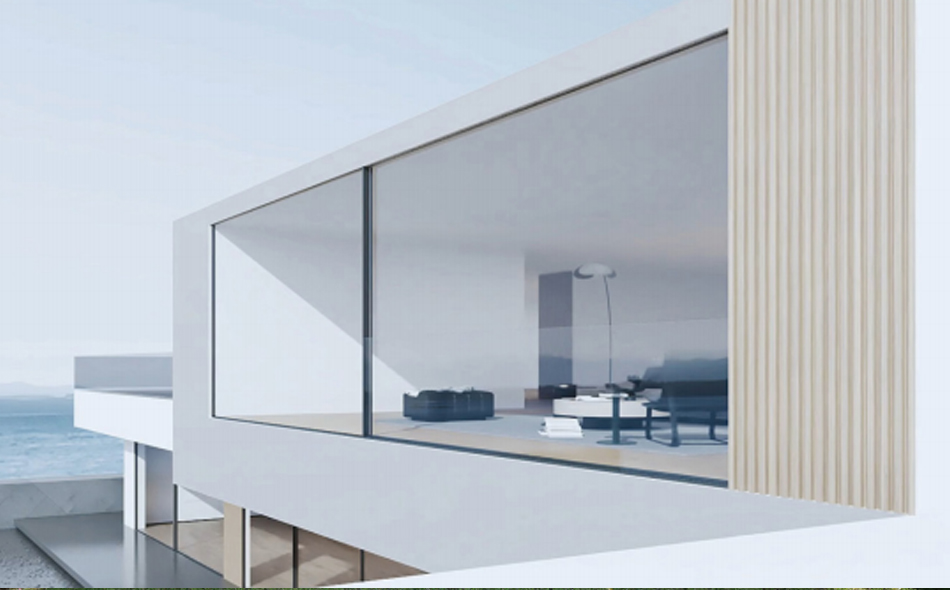
A 6-meter clear-span folding door assembly is not merely a view; it is a cantilevered structural system. Each panel, when folded, becomes a moving load transferred through a series of pivoting points to the head and floor tracks. The primary engineering challenge is not transparency, but controlling deflection under its own mass and wind load to maintain seamless operation and weather integrity over decades. Failure is measured in millimeters of misalignment.
The Structural Calculus of the Fold
Conventional sliding systems distribute load linearly. A folding system concentrates it. The terminal panel, when the door is stacked, must bear the accumulated weight of the adjacent panels through its hinged connection. For a 6-panel, 6-meter assembly with 1.2m panels, the lead post effectively supports a dynamic load exceeding 250kg. This demands a profile architecture fundamentally different from standard Sliding Doors.
Profile Integrity: The 75mm x 85mm Principle
Kingston’s folding system is engineered on a 75mm visible face width with an 85mm structural depth. This is critical. The depth provides the moment of inertia (I) to resist bending. The internal reinforcement is not a generic “strengthener” but a 2.5mm thick galvanized steel structural skeleton, mechanically fastened and fully integrated within the aluminum profile. This composite construction results in a panel weight of approximately 42kg per leaf (for a standard size), providing the necessary mass for stability without overloading the running gear.
Critical Load-Bearing Specifications
- Profile System: 75mm x 85mm thermally broken
- Structural Reinforcement: 2.5mm hot-dip galvanized steel
- Typical Panel Weight (1.2m x 2.4m): 42kg ±2kg
- Maximum Recommended Span: 3.0m per leaf (deflection limited to L/500 under design load)
- Wind Load Rating: Up to 2400Pa (Class 4, AS2047)
Kinematics & Load Path: The Running Gear as a Bridge
The hardware is the bridge between the static structure and the dynamic load. Each top hanger is a sealed, adjustable bearing assembly designed for a vertical working load of 150kg. The load path is direct: panel weight → top hanger bearing → steel reinforced head track → building structure. The floor-mounted pivot guides provide lateral restraint but are designed to carry minimal vertical load, preventing binding. The differential in load capacity between top and bottom components is intentional engineering, not oversight.
Deflection Control: The L/500 Benchmark
Under a 1.0kPa uniform load (standard for residential wind loading), a 3.0m tall panel is permitted a maximum deflection of 6mm (3000mm / 500). Our system is calibrated to achieve approximately L/650. This stiffness, derived from the profile depth and steel reinforcement, ensures that under peak gust loading, the panel alignment remains true, and the multiple compression seals engage uniformly. A deflected panel is a leaking panel.
For Coastal or High-Rise Applications
For sites exceeding standard wind loads, the system can be engineered with a 3.0mm structural reinforcement and upgraded bearing hardware. This increases the panel weight by ~8% but raises the wind load rating to 3000Pa+. This is not an “upgrade” but a necessary recalculation of the load path.
Thermal & Aural Performance: A Function of Mass and Seal
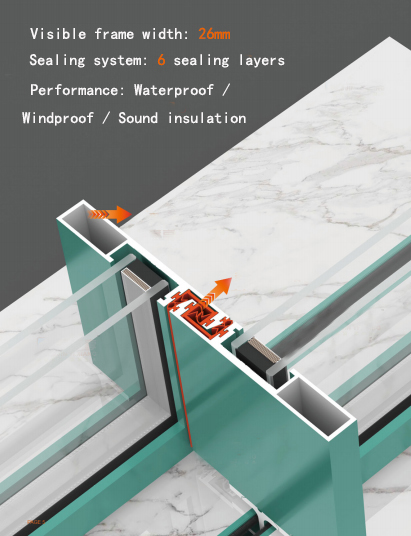
The often-cited Uw-value is a product of three factors: glass, spacer, and frame. The folding door’s thermal weakness is its perimeter length. Our 85mm deep profile accommodates a triple EPDM seal array: a primary shear seal, a central wedge seal, and a perimeter bulb seal. The mass of the panel (42kg) provides inherent acoustic damping. Combined with 24mm double glazed units (Ug=1.1), the whole assembly achieves a Uw-value of ≤1.8 W/m²K. The engineering goal is to make the joint between moving panels as performative as the fixed frame.
Installation Tolerance: ±1.5mm Over 6 Meters
The system’s precision is nullified by poor installation. The head track must be installed level within 1.5mm over its entire length. The floor track must be parallel to the head track within the same tolerance. The structural opening must be plumb and square. This is not finish carpentry; it is machine alignment. We provide full installation jigs and laser-targeted setting-out procedures.
Installation & Commissioning Protocol
- Head/Floor Track Parallelism: ≤1.5mm over full length
- Post Plumb: ≤1.0mm per 2.0m height
- Post Reinforcement: Required for all structural posts; 100x100x6mm SHS minimum
- Commissioning Load Test: Full stack operation under simulated 150kg side load
Conclusion: Engineering the Invisible
The luxury of a folding door is measured by its absence—the absence of racking, of resistance, of draft, and of maintenance. This absence is the product of visible mass (42kg panels), calculated depth (85mm), and over-engineered load paths (2.5mm steel). It is a kinetic architectural element that must be designed to the same load-bearing first principles as a bridge or a beam. The view is the reward; the engineering is the guarantee.
Next Step: Project-Specific Load Calculation
Submit your opening dimensions, site wind classification, and floor plan for a structurally calculated proposal.