
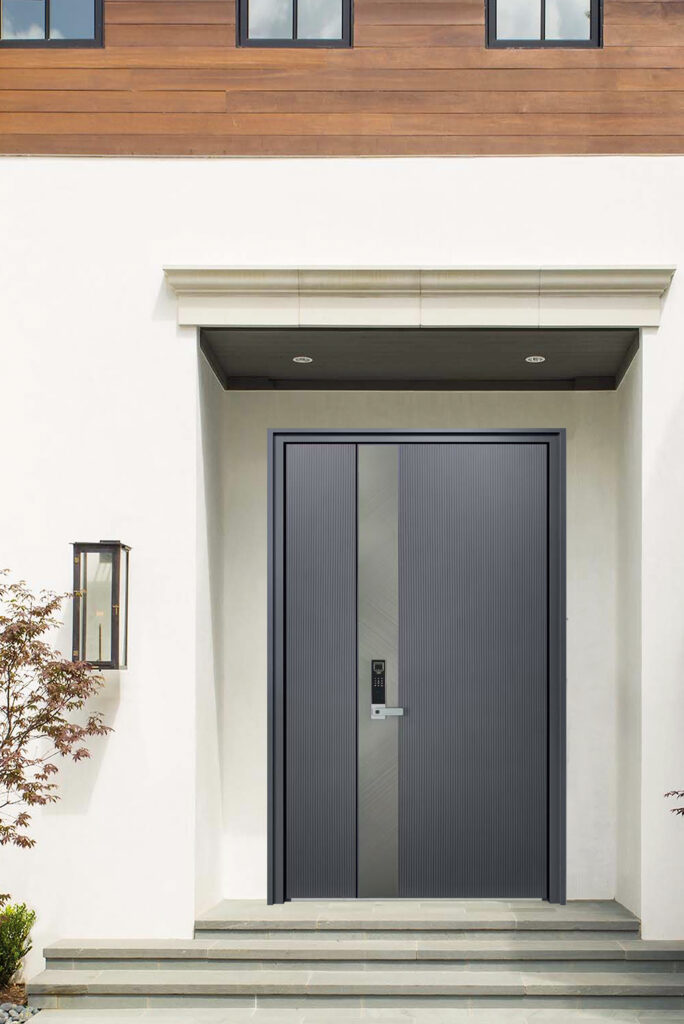
When a 6-Meter Span Isn’t Just a Door: It’s a Structural Challenge
Conventional door engineering principles collapse at spans exceeding 4 meters. Beyond this point, you are not specifying a door system; you are designing a lightweight structural beam that must resist cyclical wind loading, manage thermal expansion, and control deflection to within 1/175 of the span—all while operating on a standard track. Failure to address this from first principles results in visible sag, binding operation, and catastrophic seal failure. This is the domain of the true large-span patio system.
Fig. 1: Structural deflection analysis under 2400Pa wind load. Note the critical reinforcement at the header and sill interlock.
The Three Pillars of Large-Span Integrity: Profile, Hardware, Geometry
Large-span systems demand a holistic engineering approach. Compromising on any single element transfers stress to the others, initiating a cascade of failures.
1. Profile Section Design & Material Science
The extrusion profile is the primary load-bearing member. For spans of 5-8 meters, a nominal thickness of 3.0mm is the absolute baseline for stile and rail components. Kingston’s approach utilizes a reinforced 3.2mm 6063-T6 aluminum alloy, thermally-strutted, yielding a section modulus increase of over 25% compared to standard 2.5mm profiles. This is not about ‘more metal’; it’s about strategic mass placement. The weight of a single 6m x 2.4m moving panel can exceed 280kg. The profile must resist bending moment (M) calculated as (wL²)/8, where w is the distributed load. A 280kg panel under 1.5g acceleration imposes a significant dynamic load.
| Span Range | Minimum Profile Thickness | Typical Panel Weight (2.4m height) | Critical Failure Mode |
|---|---|---|---|
| 4m – 5m | 2.8mm | 180-220kg | Mid-span deflection > L/175 |
| 5m – 7m | 3.2mm (Reinforced) | 240-320kg | Header twist under wind load |
| 7m+ | 3.5mm+ (Custom Engineered) | 350kg+ | Hardware fatigue, track deformation |
2. Heavy-Duty Rolling Gear & Load Distribution
Standard patio door rollers are rated for <150kg. They are irrelevant here. Load-bearing rollers for large spans must use sealed, forged steel bearings with a dynamic load rating exceeding 500kg per roller. A typical 6-panel stack, with two moving leaves, requires a minimum of eight such rollers. The calculation is precise: (Panel Weight x Safety Factor of 2.5) / Number of Load-Bearing Rollers. For a 300kg panel: (300kg * 2.5) / 4 rollers = 187.5kg minimum rating per roller. We specify 250kg rollers, providing a 33% safety margin. The track must be a continuous, cold-formed steel channel of at least 4mm thickness, fully integrated into the structural aluminum header to prevent spread.
Review Roller Load Calculations
3. Deflection Control & Interlock Engineering
Deflection is the enemy of performance. AS/NZS 1170.2 requires design for a 2400Pa ultimate wind pressure in many coastal regions. On a 6m² panel, this creates a 14.4kN force. The interlock is not merely a seal point; it is a shear transfer mechanism. Our large-span systems employ a triple-sealed, multi-chambered interlock with overlapping stainless steel fingers. This creates a continuous structural moment connection when engaged, turning individual panels into a composite shear wall. The allowable deflection for smooth operation is less than 8mm over 6m (L/750). Achieving this requires a deep bottom rail design, acting as a horizontal beam, with a second moment of area (I) calculated to suppress bending.
Fig. 2: Cross-section of triple interlock under load, showing shear force transfer path.
Beyond the Unit: Structural Integration & Foundations
The best-engineered door system will fail if installed into a flexing substrate. A large-span system transfers significant point loads to the building structure at the jambs and across the header.
- Header Design: The supporting lintel or header must be engineered to resist downward load (panel weight) and wind-up lift. A steel beam is often required. We provide specific point load data for structural engineers.
- Sill Preparation: The sill must be a level, continuous structural element. A tolerance of ±1.5mm over the entire span is mandatory. Any composite foundation (e.g., concrete slab with brick veneer) must have a unified steel angle support to prevent differential movement.
- Thermal Management: A 6m aluminum profile will expand approximately 15mm between 0°C and 40°C. Fixing points must allow for this movement without inducing stress. Our systems use slotted fixing brackets with thermal pads at 600mm centers.
Specification Protocol for Consultants
To ensure performance, specify these minimums in your project documentation:
Profile & Material
Minimum 3.2mm thickness 6063-T6 thermally broken aluminum. Section modulus (Zxx) for main stile > 18.0 cm³.
Hardware
Roller dynamic load rating ≥ 250kg. Track: minimum 4mm steel, fully integrated. Multi-point locking with bolts engaging ≥ 15mm into receiver.
Performance
Air infiltration ≤ 1.0 m³/(h·m²) @ 300Pa. Water penetration resistance ≥ 600Pa. Ultimate wind load design pressure: 2400Pa. Maximum operational deflection: L/750.
Glazing
Dual-sealed laminated glass recommended for acoustic and safety performance. Must be calculated for deflection compatibility with frame.
Specifying by generic performance (e.g., “sliding door for 6m opening”) invites substitution with inadequate systems. Specify by the engineered criteria above.
The Final Calculation
A large-span patio system is a precision-engineered building component, not a commodity product. Its design is a series of solved calculations around load, deflection, and fatigue. The goal is zero-maintenance operation for decades under full environmental load. This is achieved not by over-engineering, but by correct engineering—placing material and mechanism precisely where physics demands it. When the span exceeds 5 meters, assume nothing. Calculate everything.
Key Engineering Takeaway: The limiting factor is rarely the center-span deflection of the panel itself, but the torsional flex of the header member under asymmetric wind load. Always request the header twist angle calculation from your supplier.