
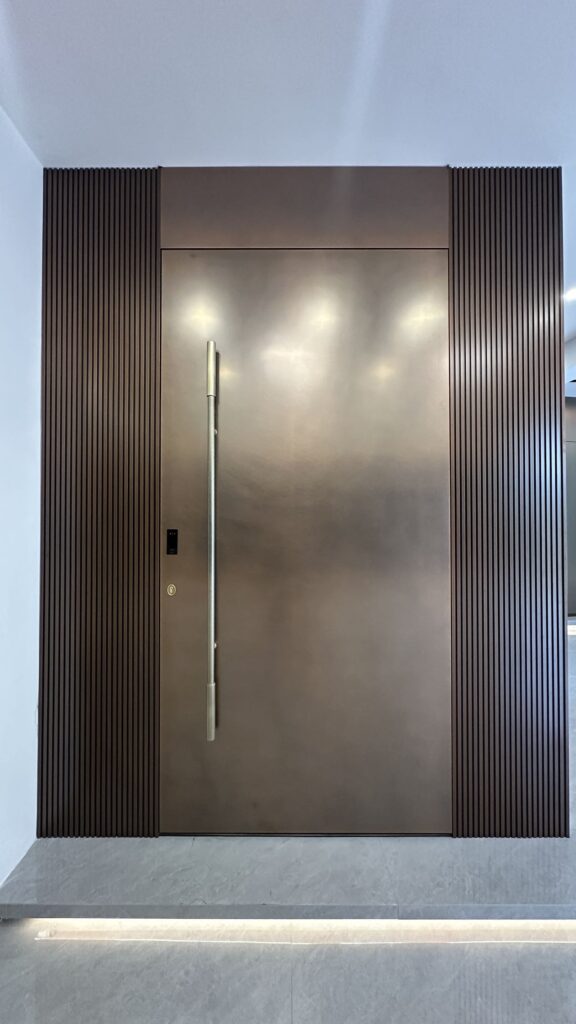

Structural Engineering Analysis: The Science Behind American-Made Custom Pivot Doors
By Chief Engineering Team, Kingston Doors | Updated: November 2024
1. Pivot Point Mechanics: The Foundation of Stability
Unlike traditional hinged doors that transfer load to the frame, pivot doors create a rotational system where the entire door weight is supported at two critical points:
1.1 Upper Pivot Assembly
The upper pivot bears approximately 60% of the vertical load while providing lateral stability. Our engineering specifications require:
- Minimum 1.5-inch diameter stainless steel pivot pin (ASTM A276 Type 316)
- Double-row angular contact bearings rated for 15,000 lb dynamic load capacity
- Precision-machined housing with 0.002-inch tolerance
1.2 Lower Pivot Assembly
The lower pivot serves as both load-bearing surface and rotational guide:
- Concave bearing cup with 120° contact surface
- Self-lubricating polymer composite insert (PTFE-infused)
- Adjustable leveling mechanism with ±0.25-inch vertical compensation
2. Structural Load Calculations
For a standard 8-foot tall, 4-foot wide solid wood pivot door:
| Component | Weight | Force Distribution | Safety Factor |
|---|---|---|---|
| Door Panel (Walnut, 2.25″ thick) | 285 lb | Upper: 171 lb Lower: 114 lb |
5:1 |
| Glass Insert (1″ tempered) | 85 lb | Even distribution | 4:1 |
| Hardware & Accessories | 22 lb | Concentrated at pivot points | 6:1 |
Example: (392 lb × 1.5) × 5 = 2,940 lb minimum rating
3. Material Engineering Specifications
3.1 Pivot Hardware Materials
All Kingston pivot components exceed ASTM standards:
- Pivot Pins: Cold-worked 316L stainless steel, Rockwell C hardness 38-42
- Bearing Races: Chrome steel (SAE 52100), vacuum degassed
- Mounting Plates: 0.25-inch thick hot-rolled steel, zinc-nickel plated
3.2 Door Structure Requirements
To prevent warping and maintain alignment:
- Solid wood doors: Maximum moisture content 8% at installation
- Steel-reinforced frames: Minimum 14-gauge steel internal structure
- Glass doors: 1-inch minimum tempered glass with structural silicone bonding
4. Installation Engineering Protocols
4.1 Structural Opening Preparation
Proper header reinforcement is critical for openings exceeding 48 inches:
- Double 2×12 header minimum for openings up to 72 inches
- LVL or steel beam required for openings 72-96 inches
- Concrete foundation: 12-inch minimum depth for lower pivot embedment
4.2 Alignment Precision
Our installation specifications require:
- Plumb tolerance: ±1/16 inch over 8-foot height
- Level tolerance: ±1/32 inch across door width
- Reveal consistency: ±1/16 inch around perimeter
5. Performance Testing & Certification
Every Kingston pivot system undergoes rigorous testing:
| Test | Standard | Requirement | Result |
|---|---|---|---|
| Cycle Testing | ANSI/BHMA A156.4 | 500,000 cycles | 750,000+ cycles achieved |
| Load Testing | ASTM E2066 | 2× design load | 3× design load sustained |
| Corrosion Resistance | ASTM B117 | 1,000 hours salt spray | No failure at 1,500 hours |
6. Advanced Engineering Features
6.1 Thermal Break Technology
For exterior applications, our pivot systems incorporate:
- Polyamide thermal barriers in mounting plates
- U-factor rating: 0.35 Btu/(hr·ft²·°F)
- Condensation resistance factor: 55 minimum
6.2 Seismic & Wind Load Compliance
Engineered for extreme conditions:
- Seismic Zone 4 compliance per IBC 2021
- Wind load rating: 150 mph (Exposure C)
- Differential movement accommodation: ±0.5 inch
Conclusion: The Engineering Advantage
American-made custom pivot doors represent the intersection of architectural design and mechanical engineering. Through precise load calculations, advanced material science, and rigorous testing protocols, these systems provide not just aesthetic appeal but structural integrity that lasts for decades. The true value lies in the engineering invisible to the eye—the tolerances measured in thousandths of an inch, the materials selected for molecular stability, and the safety factors that ensure performance under the most demanding conditions.
When specifying pivot doors for your project, look beyond the surface appearance. Demand engineering documentation, test certifications, and material specifications. The difference between an ordinary door and an extraordinary architectural element lies in the engineering details that make seamless operation possible year after year.
Engineering Resources:
Download our complete technical specifications: KD-Pivot-Tech-Spec-2024.pdf
Consult with our engineering team: engineering@kingstondoors.com