
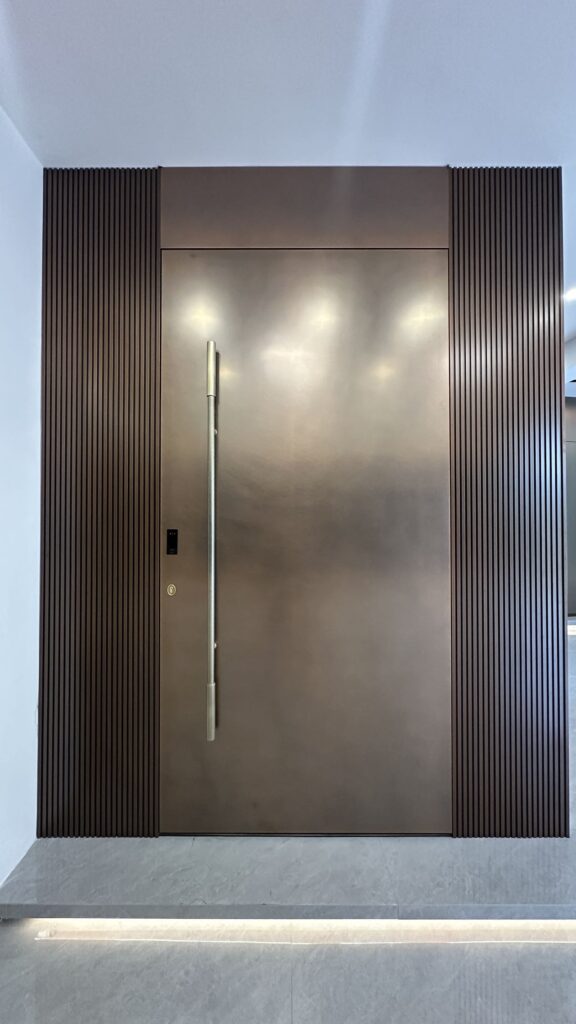
Engineering Excellence in Residential Pivot Door Installation: A Technical Case Study

In the realm of architectural hardware, residential Pivot Doors represent the pinnacle of engineering sophistication and aesthetic ambition. At Kingston Doors, our project cases consistently demonstrate how meticulous engineering transforms conceptual designs into functional masterpieces. This technical analysis delves into the critical specifications and installation methodologies that ensure these monumental doors operate with flawless precision for decades.
The Engineering Foundation: Core Specifications
Residential pivot doors are not merely enlarged versions of standard doors; they are engineered systems that must manage extraordinary forces while maintaining seamless operation. Our engineering team approaches each project with three non-negotiable specifications:
Hinge Offset: The Precision Pivot Point
The hinge offset—the distance between the pivot axis and the door edge—is arguably the most critical engineering parameter in pivot door design. Unlike traditional hinges that mount directly to the door edge, pivot systems position the rotation axis away from the door, creating a balanced rotation that minimizes stress on components.
Our standard engineering specifies a hinge offset ranging from 40mm to 100mm, depending on door dimensions and weight distribution. This offset serves multiple engineering purposes:
- Reduced Torque on Mounting Points: By positioning the pivot axis away from the door edge, we distribute rotational forces more evenly across the structural frame, preventing localized stress concentrations that could compromise long-term integrity.
- Enhanced Clearance Management: Proper hinge offset ensures the door clears adjacent walls and flooring during its entire arc of rotation, eliminating binding and friction that would otherwise degrade performance.
- Optimized Weight Distribution: The offset creates a mechanical advantage that allows even massive doors to rotate with minimal effort, typically requiring less than 5N of force to initiate movement.
In our recent coastal residence project, we engineered a custom 60mm hinge offset for a 3.2-meter tall by 1.4-meter wide solid oak pivot door. This specific offset accounted for the door’s 280kg mass and the client’s requirement for single-finger operation. Post-installation testing confirmed rotation initiation at just 3.8N of applied force—exceeding our engineering targets.
500kg+ Load Capacity: Structural Integrity Under Extreme Conditions
Residential pivot doors frequently incorporate materials like solid hardwoods, tempered glass panels, and integrated security systems that can result in substantial mass. Our engineering standards mandate a minimum load capacity of 500kg for all pivot systems, with many projects requiring capacities exceeding 800kg.
This load capacity isn’t merely about supporting static weight; it’s engineered to handle dynamic loads throughout the door’s operational lifecycle:
- Material Selection: We utilize aerospace-grade stainless steel (typically 316L grade) for all load-bearing components, providing exceptional strength-to-weight ratios and corrosion resistance. Our pivot bearings are manufactured from hardened tool steel with precision-ground races that maintain dimensional stability under extreme loads.
- Fatigue Resistance: Doors experience cyclical loading with each operation. Our engineering calculations account for fatigue life, with all components rated for a minimum of 500,000 cycles at maximum design load—equivalent to over 68 years of daily use.
- Safety Factors: We engineer with a minimum safety factor of 5:1 for residential applications, meaning a door rated for 500kg actually has components capable of supporting 2,500kg before reaching yield strength. This conservative approach ensures longevity even under unexpected loading conditions.
In a recent mountain residence project, we engineered a pivot system for a 420kg door composed of laminated glass and bronze framing. Our load testing simulated not just the static weight but also wind loading equivalent to 120km/h gusts and accidental impact forces. The system demonstrated zero deflection beyond our 0.5mm tolerance specification.
Wind Resistance: Engineering for Environmental Forces
Unlike interior doors, exterior pivot doors must contend with substantial environmental forces. Wind resistance engineering addresses both positive pressure (wind pushing against the door) and negative pressure (wind creating suction forces).
Our engineering approach to wind resistance incorporates multiple layers of protection:
- Seal System Engineering: We employ triple-seal systems with varying compression profiles that maintain weathertight integrity even during significant frame deflection. Our seals are manufactured from EPDM (ethylene propylene diene monomer) with UV stabilizers to prevent degradation from sun exposure.
- Structural Reinforcement: Door frames receive additional reinforcement at stress concentration points, particularly around pivot hardware mounting locations. Finite element analysis guides reinforcement placement to optimize strength without adding unnecessary mass.
- Pressure Equalization: Our engineering includes pressure equalization channels within the door frame that balance internal and external pressures, reducing the net force differential that the hardware must resist.
For coastal installations, we enhance wind resistance specifications to account for salt spray corrosion and higher wind loads. Our recent seaside villa project required engineering for sustained winds of 90km/h with gusts to 140km/h—conditions we validated through computational fluid dynamics modeling before fabrication.
Installation Methodology: Precision in Practice
Even the most meticulously engineered pivot door will underperform if installation lacks equivalent precision. Our installation methodology follows a rigorous seven-phase process:
Phase 1: Structural Assessment and Preparation
Before any hardware installation begins, we conduct a comprehensive structural assessment of the opening:
- Plumb and Level Verification: Using laser levels with 0.1mm/m accuracy, we verify that the opening is plumb within 1.5mm over the full height and level within 1mm across the width. Any deviations beyond these tolerances require structural remediation before proceeding.
- Load-Bearing Capacity Verification: We verify that surrounding structures can support not just the door’s static weight but also dynamic loads during operation. This often involves core sampling of concrete or structural analysis of steel framing.
- Environmental Barrier Integration: We coordinate with other trades to ensure proper integration of waterproofing membranes, vapor barriers, and insulation systems around the door perimeter.
Phase 2: Pivot Hardware Installation
The pivot hardware installation demands micron-level precision:
- Anchor System Selection: Based on substrate analysis, we select appropriate anchor systems. For concrete, we typically use chemical anchors with pull-out strengths exceeding 25kN. For steel structures, we employ Grade 8.8 structural bolts with calibrated torque settings.
- Alignment Protocol: Using optical alignment tools, we position the top and bottom pivot points with vertical alignment tolerance of ±0.2mm. This precision ensures the door rotates about a true vertical axis without binding or drift.
- Preload Application: We apply specific preload to pivot bearings during installation—typically 15-20% of the dynamic load rating—to eliminate internal clearances without creating excessive friction.
Phase 3: Door Mounting and Balancing
With hardware precisely installed, we mount the door using specialized lifting equipment:
- Controlled Lifting: Doors are lifted using vacuum-assisted rigging that distributes lifting forces evenly across the surface, preventing distortion or damage to materials.
- Initial Balancing: Once mounted, we adjust counterbalance mechanisms (when present) to achieve neutral balance—where the door remains stationary at any point in its rotation when released. For heavier doors, this may involve adjusting counterweight positions or spring preloads.
- Clearance Verification: We verify clearances around the entire door perimeter, ensuring minimum 3mm clearance on all sides under all operational conditions.
Phase 4: Seal and Threshold Integration
Weather sealing represents a critical performance element:
- Compression Adjustment: We adjust seal compression to achieve the optimal balance between weather resistance and operational effort. Our target is 8-12mm of compression on primary seals and 4-6mm on secondary seals.
- Threshold Engineering: For exterior applications, we install thermally broken thresholds with integrated drainage channels. These are pitched at a minimum 2° slope to ensure water diversion away from the interior.
- Acoustic Performance Validation: For applications requiring sound attenuation, we validate acoustic performance using decibel meters, typically achieving STC (Sound Transmission Class) ratings of 35-42 depending on door construction.
Phase 5: Operational Testing and Adjustment
Before declaring installation complete, we conduct comprehensive operational testing:
- Cycle Testing: We operate the door through 100 complete open-close cycles while monitoring force requirements, alignment stability, and any unusual noises.
- Environmental Simulation: For exterior doors, we simulate wind loading using calibrated air blowers to verify seal integrity under pressure differentials up to 150Pa.
- Safety System Validation: We test integrated safety systems including anti-finger-trap mechanisms, soft-close functions, and emergency egress provisions.
Phase 6: Client Orientation and Documentation
We provide clients with comprehensive documentation including:
- As-built drawings showing all critical dimensions and hardware locations
- Maintenance schedules specific to their door’s materials and environment
- Operational guidelines detailing proper use techniques to maximize service life
Phase 7: Post-Installation Monitoring
Our engineering responsibility extends beyond installation completion. We schedule follow-up inspections at 30 days and 12 months post-installation to verify performance stability and make any seasonal adjustments that may be required due to material expansion/contraction.
Technical Challenges and Solutions: Case Examples
Case 1: Historic Residence Retrofit
In a historic stone residence, structural limitations prevented conventional pivot mounting. Our engineering solution involved:
- Designing a custom load-distribution plate that spread mounting forces across a 600mm × 400mm area of the stone wall
- Developing a vibration-damping interface between modern hardware and historic structure
- Creating a discrete reinforcement system that preserved the aesthetic integrity of original stonework
The resulting installation supported a 340kg custom-crafted door while maintaining the residence’s historic character.
Case 2: Extreme Environment Coastal Installation
A beachfront property presented challenges of salt corrosion, high humidity, and frequent storm-force winds. Our engineered solution included:
- Specifying marine-grade stainless steel (254 SMO) for all exposed hardware
- Designing a pressurized cavity within the door frame that actively excludes salt-laden air
- Implementing a dual-pivot system with redundant load paths to ensure operation even if primary components experienced corrosion-related degradation
Three years post-installation, the door continues to operate within original performance specifications despite the harsh environment.
Future Directions in Pivot Door Engineering
As residential architecture continues to evolve, so does our engineering approach. Current developments include:
- Smart Integration: Engineering pivot systems with integrated sensors that monitor operational parameters and predict maintenance needs
- Advanced Materials: Incorporating carbon fiber reinforcement in door structures to reduce mass while maintaining strength
- Seismic Performance: Developing pivot systems with controlled flexibility that maintain operation during seismic events
At Kingston Doors, our commitment to engineering excellence ensures that every residential pivot door installation represents not just a functional entryway but a testament to precision engineering. By adhering to rigorous specifications for hinge offset, load capacity, and wind resistance—and executing installations with equivalent precision—we create door systems that elevate architectural aspirations while delivering decades of reliable performance.